Airspace Classes Explained: A, B, C, D, E and G
Airspace classes explained: the US uses six classes—A, B, C, D and E are controlled; G is uncontrolled. For ordinary VFR arrival or through flight, Class B needs an explicit ATC clearance, Class C and D need established two-way radio communication, and Class E and G have no general airspace-entry radio requirement. Identify the class at your position and altitude, then check its weather, equipment and pilot requirements (FAA AIM, Chapter 3).

On this page
- What are the key facts about each class?
- Does controlled airspace always require a radio call?
- How do you recognize airspace on a sectional?
- What do Class B shelf numbers mean?
- What radio response lets you enter Class B, C or D?
- Where does Class E begin, and what lies below it?
- Which weather and equipment rules also apply?
- What else should you check beyond the class letter?
- Check yourself
- Frequently asked questions
- What should you study next?
- Sources and review notes
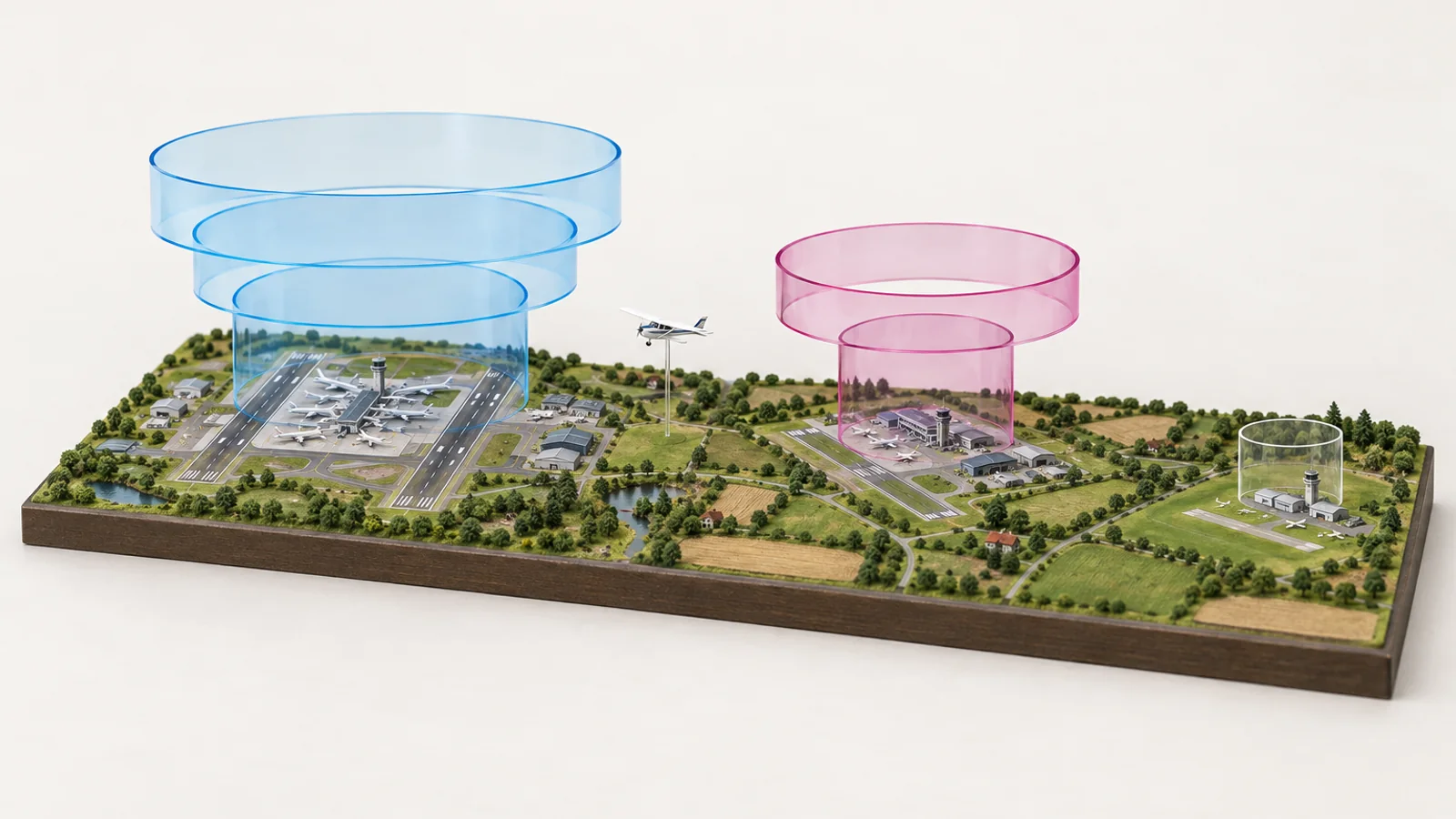
This hub covers US private-pilot airplane study. It connects the chart picture to the entry rule, then to the other conditions that still matter. The miniature hero illustrates the idea of airspace volumes; it does not depict real boundaries or navigational dimensions.
What are the key facts about each class?
The letter identifies an airspace designation, not a universal shape or an automatic permission to enter.
| Class | Typical location or extent | Entry rule to remember | Official source |
|---|---|---|---|
| A | Generally 18,000 feet MSL through and including FL600 | Normally IFR with an ATC clearance | AIM 3-2-2, 91.135 |
| B | Tailored layers around major airports; generally surface to 10,000 feet MSL | Explicit ATC clearance before entry | AIM 3-2-3, 91.131 |
| C | Usually a 5 NM surface core and 10 NM shelf; top generally 4,000 feet above airport elevation, charted in MSL | Two-way communication before VFR arrival or through flight | AIM 3-2-4, 91.130 |
| D | Tailored surface area; generally to 2,500 feet above airport elevation, charted in MSL | Two-way communication before VFR arrival or through flight | AIM 3-2-5, 91.129 |
| E | Controlled airspace serving terminal and en route purposes; floors vary | No general VFR entry call solely because it is Class E | AIM 3-2-6 |
| G | Airspace not designated A, B, C, D or E | No general VFR entry call solely because it is Class G | AIM 3-3-1 |
MSL means mean sea level; AGL means above ground level. NM means nautical miles. Weather visibility is usually expressed in statute miles, so keep the units attached to the number.
Does controlled airspace always require a radio call?
No: Class E is controlled airspace, yet ordinary VFR flight has no general Class E entry-call requirement.
“Controlled” describes the airspace and ATC services, including services for IFR operations. It does not mean every VFR aircraft receives the same service or needs the same entry permission. Class A normally requires IFR; Class B adds an explicit clearance; Class C and D require established two-way communication for arrivals and through flights.

A classification and entry-rule overview, not an altitude profile. Class A normally requires IFR; authorized deviations are separate.
The United States does not use Class F in this classification. Class G still has operating and weather rules: “uncontrolled” does not mean unrestricted. If designations overlap, the operating rules of the more restrictive designation apply (AIM 3-1-3).
How do you recognize airspace on a sectional?
Read the line style, color, altitude labels and operating notes together.
| Sectional cue | What it indicates | What to read next |
|---|---|---|
| Solid blue boundary | Class B | Sector floor and ceiling, plus surrounding equipment requirements |
| Solid magenta boundary | Class C | Core and shelf altitudes, and approach frequency |
| Dashed blue boundary | Class D | Boxed ceiling in hundreds of feet MSL and effective hours |
| Dashed magenta boundary | Class E surface area or extension | Extent, notes and effective hours where applicable |
| Faded magenta band | A 700-foot-AGL Class E floor on the indicated side | Adjoining airspace and any overlapping designation |
| Blue vignette or other Class E floor annotation | Commonly a 1,200-foot-AGL transition floor; other designated floors exist | The chart's specific floor and applicable legend |
Source: FAA Aeronautical Chart Users' Guide, VFR Terms and Symbols, pages 16–17, and Airspace Information, pages 26–27. The current linked edition is dated July 9, 2026.
The chart gives a plan view of volumes. A point inside an outer ring is not necessarily inside that class at every altitude. A nearby Class B Mode C veil is also not the Class B boundary. Recognizing blue or magenta alone cannot answer the whole question.
What do Class B shelf numbers mean?
Class B sector ceiling and floor numbers are in hundreds of feet MSL, with the ceiling above the floor.
In an original teaching example, 100/40 means a ceiling of 10,000 feet MSL and a floor of 4,000 feet MSL. An airplane at 3,500 feet MSL beneath that sector is below its Class B floor. That does not identify the underlying class or remove equipment requirements in surrounding airspace.

A hypothetical sector only, with compressed vertical scale. The airplane is at 3,500 feet MSL; its underlying airspace must be checked separately.
Some charted floors carry a plus sign, indicating a floor extending upward from above the stated altitude. Class D ceiling labels can carry a minus sign, meaning the stated ceiling is excluded. Read those marks rather than treating every boundary the same (Chart Users' Guide, pages 16 and 27).
Class C's familiar 5 NM core and 10 NM shelf are typical dimensions, not guarantees. The shelf generally starts no lower than 1,200 feet above airport elevation, and the top is generally 4,000 feet above airport elevation; both are charted as MSL values. Real configurations are individually tailored.
What radio response lets you enter Class B, C or D?
Class B needs explicit clearance; Class C and D need your aircraft identification acknowledged in established two-way communication, subject to ATC instructions.
For Class C or D, a response such as “N123AB, standby” establishes communication. A response such as “Aircraft calling, standby” does not identify your aircraft and does not establish the required communication. A callsign followed by “remain outside” means you must remain outside, even though communication exists.

Original, simplified radio examples for VFR arrivals and through flights. A landing clearance is a separate requirement.
For Class B, hearing your callsign or being told you are radar identified is insufficient by itself. Obtain the actual Class B clearance before entry. If the message is unclear, clarify while remaining outside. Being on flight following does not by itself meet a new airspace-entry requirement (AIM 3-2-1, 3-2-3, 3-2-4 and 3-2-5).
Call early enough to resolve the exchange before reaching the boundary. Use the appropriate facility providing services for that airspace. Departures from satellite airports have their own provisions in 91.129(c) and 91.130(c); do not apply the arrival example to every departure.
Where does Class E begin, and what lies below it?
Class E can begin at the surface, 700 feet AGL, 1,200 feet AGL or another designated altitude; identify its actual floor.
Where a Class E floor is 700 feet AGL and no other controlled designation applies below it, the lower airspace is Class G. At another location, a Class E surface area leaves no Class G layer underneath. Federal airways, transition areas and en route areas are further Class E configurations; “E always starts at 700” is incorrect.
An AGL floor follows the reference to ground elevation rather than a fixed sea-level height. Over hypothetical terrain at 500 feet MSL, a 700-foot-AGL floor corresponds to 1,200 feet MSL. Keep the example's terrain assumption attached to the calculation. For weather-minimum purposes, 91.155(e) treats an aircraft exactly at a Class E base altitude as in the airspace directly below it.
When a part-time Class D tower closes, the surface area may revert to Class E or Class G. Check the airport's Chart Supplement and effective hours; do not assume every closed tower creates Class G (AIM 3-2-5 and 3-2-6).
Which weather and equipment rules also apply?
Entry permission is one condition; weather, aircraft equipment and pilot limitations must also fit the operation.
| Basic VFR situation | Flight visibility | Distance from clouds |
|---|---|---|
| Class B | 3 statute miles | Clear of clouds |
| Class C or D; Class E below 10,000 feet MSL | 3 statute miles | 500 feet below, 1,000 feet above, 2,000 feet horizontally |
| Class E at or above 10,000 feet MSL | 5 statute miles | 1,000 feet below, 1,000 feet above, 1 statute mile horizontally |
| Class G | Depends on altitude, day/night and aircraft category | Use the applicable row and exceptions in 91.155 |
Source: 14 CFR 91.155. This overview deliberately points Class G readers to its full rules. Controlled airport surface areas also have ceiling and takeoff/landing/traffic-pattern visibility provisions in paragraphs (c) and (d). Special VFR is a separate authorization and set of rules, not an automatic alternative.
A student pilot acting as PIC also needs at least 3 statute miles flight or surface visibility by day and 5 at night, visual reference to the surface, and compliance with instructor limitations under 61.89(a)(6)–(8). A lower general Class G minimum does not override these student restrictions. Legal minima also do not establish a personal weather margin.
For the usual equipped trainer, Class B and C require a two-way radio, altitude-reporting transponder and ADS-B Out unless appropriately authorized otherwise. Class D alone does not create a blanket transponder/ADS-B requirement, but its location may trigger one: the 30 NM Mode C veil around specified airports extends from the surface upward to 10,000 feet MSL. Requirements also apply above B/C ceilings within their lateral boundaries, and in specified higher-altitude airspace. Check 91.215 and 91.225, including aircraft exceptions and deviations.
Student solo operations in Class B need the specific training and recent instructor endorsements required by 61.95. Some listed primary airports require at least a private pilot certificate for takeoff or landing under 91.131(b)(2). An ATC clearance cannot substitute for pilot eligibility.
What else should you check beyond the class letter?
Check applicable special use airspace, temporary restrictions, airport procedures and current operating information as well.
An MOA, restricted area or temporary restriction is not another letter in the A–G classification. Each adds its own considerations or requirements. Use the applicable published information rather than assuming that a Class E or G location is free of other restrictions (AIM Chapter 3 overview).
For study, work in a consistent order: locate the point, read the vertical limits, identify the class, check entry communication or clearance, then check weather, equipment, pilot eligibility and additional restrictions. Explain each step aloud on an unfamiliar chart example. This is an editorial learning sequence, not an FAA checklist.
Check yourself
These are original learning scenarios, not released FAA test questions.
1. Approach says “N123AB, standby” before Class C. Is communication established?
Show the answer
Yes: the controller used your aircraft identification. Provided you have not been instructed to remain outside, that meets the two-way communication condition for this arrival or through flight. You must still satisfy equipment, weather and other applicable requirements. The same response alone would not grant Class B clearance.
2. You are at 3,500 feet MSL beneath a Class B sector labeled 100/40. Are you in that sector?
Show the answer
No. Its floor is 4,000 feet MSL, so you are 500 feet below it. Determine the underlying class and any separate equipment requirements. Being below a Class B shelf does not automatically mean you are in Class G or outside the Mode C veil.
3. A part-time Class D tower closes. Must the surface area become Class G?
Show the answer
No. It may become Class E or Class G as published. Check the Chart Supplement for that airport and the chart's effective-hours notes. A tower's closed status alone does not identify the replacement designation or weather requirements.
Frequently asked questions
Why is there no Class F in US airspace?
The US classification uses A, B, C, D, E and G. For US private-pilot study, learn those six rather than inventing an intermediate F layer. Other countries can use different classifications and procedures; this guide covers the United States.
Does Class E require an ATC clearance for VFR?
There is no general Class E VFR airspace-entry clearance requirement. Weather, equipment where required, airport procedures and other restrictions still apply. IFR operations have different requirements; do not generalize the VFR entry rule to IFR flight.
Is the 30 NM Mode C veil the same as Class B?
No. It defines surrounding equipment-required airspace under 91.215 and 91.225, subject to exceptions and authorizations. Class B has its own tailored lateral and vertical boundaries. You can be outside Class B while still within the veil.
Can a Class D entry radio call replace a landing clearance?
No. Established two-way communication meets an airspace-entry condition; it is not a clearance to land. 91.129(i) separately requires appropriate ATC clearance for runway/taxiway operations and takeoff or landing at an airport with an operating tower.
What should you study next?
Use this hub for the overall map, then work through the individual airspace questions.
The following guides are planned; their links become available as the articles go live:
- VFR weather minimums by airspace
- Class B clearances, equipment and student rules
- Class C two-way radio communication
- Class D requirements and chart cues
- Class E versus G: floors and shading
- Special use airspace
For the test process, read the live private pilot written-test guide. Use your knowledge-test report and ACS codes to organize missed-topic review, and what a good written score means to evaluate preparation beyond one percentage.
Practice airspace knowledge with FirstSolo.ai, then discuss unresolved chart or rule questions with your instructor. FirstSolo.ai is solely a study tool and does not issue endorsements now or in the future.
Sources and review notes
- FAA AIM Chapter 3, Sections 1–2: controlled airspace, typical dimensions, VFR entry and radio examples; Section 3: Class G.
- FAA Aeronautical Chart Users' Guide, linked July 9, 2026 edition, pages 16–17 and 26–27: chart cues, MSL labels, plus and minus signs.
- 14 CFR 91.129, 91.130, 91.131 and 91.135: D, C, B and A operating rules.
- 14 CFR 91.155, 91.215 and 91.225: VFR weather and equipment requirements.
- 14 CFR 61.89 and 61.95: student pilot limitations and Class B solo requirements.
Facts checked October 10, 2026. Typical dimensions are qualified; current charts and operating notes determine actual boundaries. Diagrams and scenarios are original teaching aids. Human technical review remains pending.
FirstSolo.ai is independent and is not affiliated with or endorsed by the FAA.
About the author
Sam Whitaker, Student PilotSam is a student pilot training in a Piper Warrior outside Denver, Colorado, fitting lessons around a full-time job. He writes up the practical side of the FAA written, from booking the test to what to bring on the day, with the FAA source for every rule.
Last reviewed Oct 10, 2026All guides by SamKeep going
A fresh question from the FAA references every time, graded by an AI DPE
Start with 50 free credits.
Start free