The FAA Private Pilot Written Test: Complete 2026 Guide
The FAA private pilot written, officially the Private Pilot Airplane (PAR) knowledge test, is a 60-question multiple-choice exam you take in person at an FAA-approved testing center. You get 2 hours, need 70% to pass, and pay about $175. You can take it from age 15 with an instructor's endorsement, and a pass stays valid for 24 calendar months.


On this page
- Key facts at a glance
- What is the private pilot written?
- What's on the test?
- Who can take the test?
- How do you book it?
- What happens on test day?
- How is it scored, and what's a good score?
- What do the codes on your test report mean?
- What happens if you fail?
- How long is a pass valid?
- When should you take it?
- How should you study for it?
- Check yourself
- Frequently asked questions
- Sources
Key facts at a glance
| Official name | Private Pilot Airplane knowledge test (test code PAR) |
|---|---|
| Format | 60 multiple-choice questions, three answer choices each |
| Time allowed | 2 hours |
| Passing score | 70%, which is 42 of 60 correct |
| Cost | About $175 per attempt, paid when you book |
| Minimum age | 15 (the certificate itself requires 17) |
| What you need | An instructor endorsement or a Part 141 graduation certificate, a government photo ID, and an FAA Tracking Number to book |
| How long a pass lasts | 24 calendar months |
| 2025 results | 44,657 tests taken, 89.6% passed, average score 81.6% |
Sources: FAA Airman Knowledge Testing Matrix (effective September 25, 2026) and FAA knowledge test statistics for 2025.
What is the private pilot written?
It's the knowledge half of earning a private pilot certificate. To get the certificate you pass two FAA tests: this computer-based knowledge test, and a practical test (the checkride) with an examiner, which includes an oral exam and a flight. Passing the knowledge test is a requirement under 14 CFR 61.103(e).
Pilots still call it "the written," but there's no paper involved anymore. You answer on a computer at a testing center, and you see your score as soon as you finish.
What's on the test?
The questions cover the aeronautical knowledge areas in 14 CFR 61.105(b), organized by the Private Pilot Airman Certification Standards (ACS, FAA-S-ACS-6C). In practice that means:
- Regulations and documents: pilot and aircraft certificates, required inspections, student pilot limits, right-of-way, alcohol and drug rules
- Airspace: the classes from A to G, VFR weather minimums, special use airspace, TFRs
- Weather: reading METARs, TAFs and other reports, plus weather theory like fronts, fog, thunderstorms and icing
- Performance and weight and balance: density altitude, takeoff and landing charts, center of gravity calculations
- Navigation: sectional charts, plotting courses, VORs, wind correction and fuel planning
- Aerodynamics, systems and instruments: the four forces, stalls, load factor, the engine, and pitot-static and gyroscopic instruments
- Human factors: decision-making, hypoxia, spatial disorientation, fitness to fly
- Airport operations, emergencies and night flying: markings, signs and lighting, light gun signals, wake turbulence, and the night rules

Many questions refer to a figure: a sectional chart excerpt, a weather report, a performance chart. Those come from the FAA's Airman Knowledge Testing Supplement (FAA-CT-8080-2H), which covers sport, recreational, remote and private pilots. The testing center provides it on test day, and it's free to download, so practice with the same figures you'll see.
Every question is tied to an ACS code that names the knowledge area it tests. Those codes matter after the test, as you'll see below.
Who can take the test?
You can take the PAR test once you meet three conditions:
- You're at least 15. The FAA sets the minimum age for this test at 15, two years before the certificate's minimum age of 17. The rule is that you must reach the certificate's age before your test report expires (14 CFR 61.35).
- You have an endorsement. An authorized instructor who gave you ground training, or who reviewed your home study, endorses that you're prepared, usually in your logbook (14 CFR 61.103(d)). If you train at a Part 141 school, a graduation certificate from its ground school works instead. Some online ground school courses include an instructor endorsement when you finish.
- You bring valid identification. The FAA testing matrix asks for a government-issued photo ID showing your photo, date of birth, signature and residential address.
You don't need a medical certificate to take the knowledge test, and you don't need any flight time.
How do you book it?
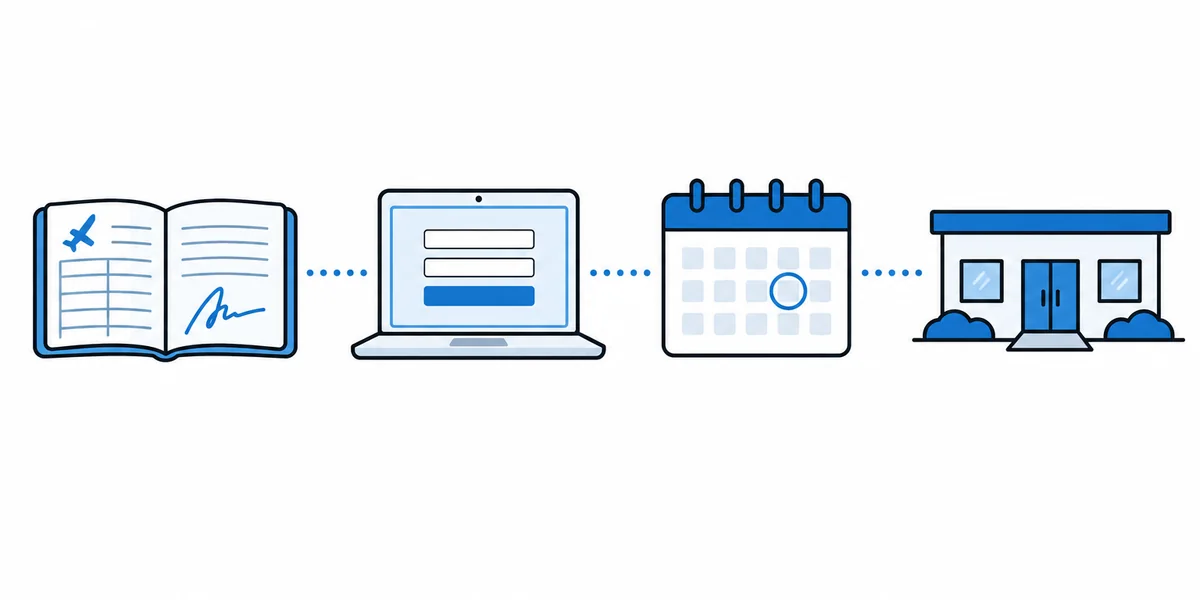
Once you have your endorsement, booking is four steps:
- Get an FAA Tracking Number (FTN). Register as an applicant in IACRA, the FAA's certification system, using your name exactly as it appears on your ID.
- Create an account with PSI, the company that runs FAA testing centers, at faa.psiexams.com. Use the same legal name you used in IACRA.
- Choose the test and a center. Select Private Pilot Airplane (PAR), pick a testing center near you, and choose a date and time.
- Pay the fee, $175 at PSI's standard rate, and keep the confirmation email.
What happens on test day?
Arrive early with your photo ID and your endorsement. The proctor checks both, checks your materials, and seats you at a computer in a monitored room. You can bring a flight computer (E6B), a plotter and an approved calculator; ask your testing center ahead of time what they accept.
The FAA cut the time limit from 2.5 hours to 2 in April 2023. The 2-hour clock gives you an average of 2 minutes per question, which is plenty for most questions and tight for a few long calculations. You can mark questions to review and return to them before you finish.
When you finish, you see your score. Your result is recorded with the FAA and appears on your Airman Knowledge Test Report (AKTR), which you'll need at your checkride.
How is it scored, and what's a good score?
You need 70%, which is 42 correct answers out of 60. Most people pass: in 2025, 89.6% of the 44,657 private pilot tests taken were passes, and the average score was 81.6%. Both numbers dipped from 2024, when 91.9% passed with an average of 82.9% (FAA test statistics, 2024).
| Year | Tests taken | Passed | Average score |
|---|---|---|---|
| 2024 | 46,132 | 91.9% | 82.9% |
| 2025 | 44,657 | 89.6% | 81.6% |
The counts are tests taken, not people, so retakes are likely included.
A pass is a pass, but the score still matters. An average of 81.6% means the average test-taker misses about 11 questions, and the knowledge areas behind those misses follow you to the checkride.
What do the codes on your test report mean?
Your AKTR doesn't list the questions you missed. It lists the ACS codes for the knowledge areas behind them, so you and your instructor know exactly what needs work. Here's how to read a code like PA.I.E.K1:
| Part | Means |
|---|---|
| PA | Private Pilot, Airplane |
| I | Area of Operation I: Preflight Preparation |
| E | Task E: National Airspace System |
| K1 | Knowledge element 1: airspace classes and their requirements and limitations |
Some elements have lettered parts. PA.I.B.K1b, for example, is "required inspections and airplane logbook documentation" under Task B, Airworthiness Requirements.
These codes aren't just feedback. Before your checkride, your instructor has to give you training on every deficient area and endorse that you now know it (14 CFR 61.39). Your examiner reviews the same report and assesses those areas during the checkride.

What happens if you fail?
You can retest, but not straight away on your own. Under 14 CFR 61.49, you first get more training from an authorized instructor, who then endorses you for the retest. You bring the failed test report and the new endorsement to the testing center and pay the fee again. The FAA testing matrix lists no extra waiting period for the PAR retest.
How long is a pass valid?
You must complete your checkride within 24 calendar months of passing. Precisely, the knowledge test has to fall within the 24 calendar months before the month you complete the practical test (14 CFR 61.39(a)(1)). If you pass in October 2026, you have until the end of October 2028.
When should you take it?
Take it once you've finished ground school or covered every knowledge area on your own, and while the material is fresh. With 24 months of validity, most students can take it partway through flight training with little risk of it expiring. Getting it done early also frees your last weeks of training for the flying and the oral.
How should you study for it?
Study to understand the rules, not to recognize the questions. The FAA's own sample questions show the style, and the core sources are free from the FAA:
- Pilot's Handbook of Aeronautical Knowledge (FAA-H-8083-25C)
- Airplane Flying Handbook (FAA-H-8083-3C)
- Aeronautical Information Manual
- 14 CFR Part 61 and Part 91
- The Private Pilot ACS and the testing supplement
A few habits make the biggest difference:
- Work by ACS area. Finish one area before starting the next, so gaps show up clearly.
- Practice with the real figures. Read the sectional excerpts and performance charts from the supplement until they're routine.
- Time a full mock exam. Sixty questions in two hours, at least twice before test day.
- Explain your answers out loud. If you can't say why the right answer is right, you've memorized it, and the oral will find that out.
We built FirstSolo.ai around that last point. When we studied for the written, we used apps with a fixed bank of questions. After a few weeks we were answering in three seconds without really reading the question, and getting most of them right. That's recognition, not knowledge. FirstSolo writes a fresh question from the FAA references every time, so there's nothing to memorize, and its AI DPE grades your answers in your own words and explains the rule when you get one wrong. You can start with 50 free credits, and our E6B flight computer is free with no sign-in.
Check yourself
1. How many questions does the PAR test have, and how many must you get right to pass?
Show the answer
60 questions; you need 70%, which is 42 correct.
2. You pass the knowledge test on March 10, 2026. What's the last date you can complete your checkride?
Show the answer
March 31, 2028. The window is 24 calendar months before the month of the practical test, so it runs to the end of the month.
3. Besides a photo ID, what must you show to take the test?
Show the answer
An endorsement from an authorized instructor, or a graduation certificate from a Part 141 ground school.
Frequently asked questions
Is the private pilot written hard?
It's very passable with preparation: 89.6% of tests taken in 2025 were passes. The harder part is scoring well enough that you understand every area your examiner might ask about.
Can I take the written before I start flying?
Yes. You need an endorsement, which an instructor can give after reviewing your home study, but you don't need any flight time. Just make sure you'll reach your checkride within 24 calendar months.
Do I need a medical certificate to take the written?
No. The knowledge test requires an endorsement and a photo ID, not a medical.
Can I take the FAA written online?
No. You take it in person at an FAA-approved testing center, booked through PSI.
Is the written the same as the checkride oral?
No. The written is a multiple-choice test on a computer. The oral is a conversation with an examiner during your practical test, and it often starts with the areas you missed on the written.
Sources
- FAA Airman Knowledge Testing Matrix, effective September 25, 2026
- FAA Airman Knowledge Test statistics, 2025 and 2024
- 14 CFR 61.35, 61.39, 61.49, 61.103 and 61.105
- Private Pilot Airman Certification Standards (FAA-S-ACS-6C)
- Airman Knowledge Testing Supplement (FAA-CT-8080-2H)
- FAA sample questions for the PAR test
- FLYING: FAA reduces time allotted for knowledge tests
About the author
Ellie Navarro, Student PilotEllie is a student pilot working toward her private pilot certificate in a Cessna 172 near Austin, Texas. She writes up each part of the FAA written the way it finally made sense to her, with the FAA source for every rule.
Last reviewed Oct 3, 2026All guides by EllieKeep going
A fresh question from the FAA references every time, graded by an AI DPE
Start with 50 free credits.
Start free