Class B Airspace Requirements: A Pilot's Guide
Class B airspace requirements include explicit ATC clearance, an eligible pilot, and required radio, altitude-reporting transponder and ADS-B Out equipment, subject to applicable authorizations. Basic VFR needs 3 statute miles flight visibility and clear of clouds. Private-pilot students also need specific solo training and recent instructor endorsements, and cannot solo take off or land at the listed airports requiring at least a private pilot certificate (91.131, 61.95).

On this page
- What are the key Class B requirements?
- What counts as a Class B clearance?
- How do you read Class B shelves on a chart?
- What equipment does a VFR airplane need?
- Is the 30 NM Mode C veil the Class B boundary?
- Can a student pilot solo in Class B?
- Which airports prohibit student solo takeoff or landing?
- What weather and speed limits should you check?
- What should you plan before a Class B flight?
- Check yourself
- Frequently asked questions
- What should you study next?
- Sources and review notes
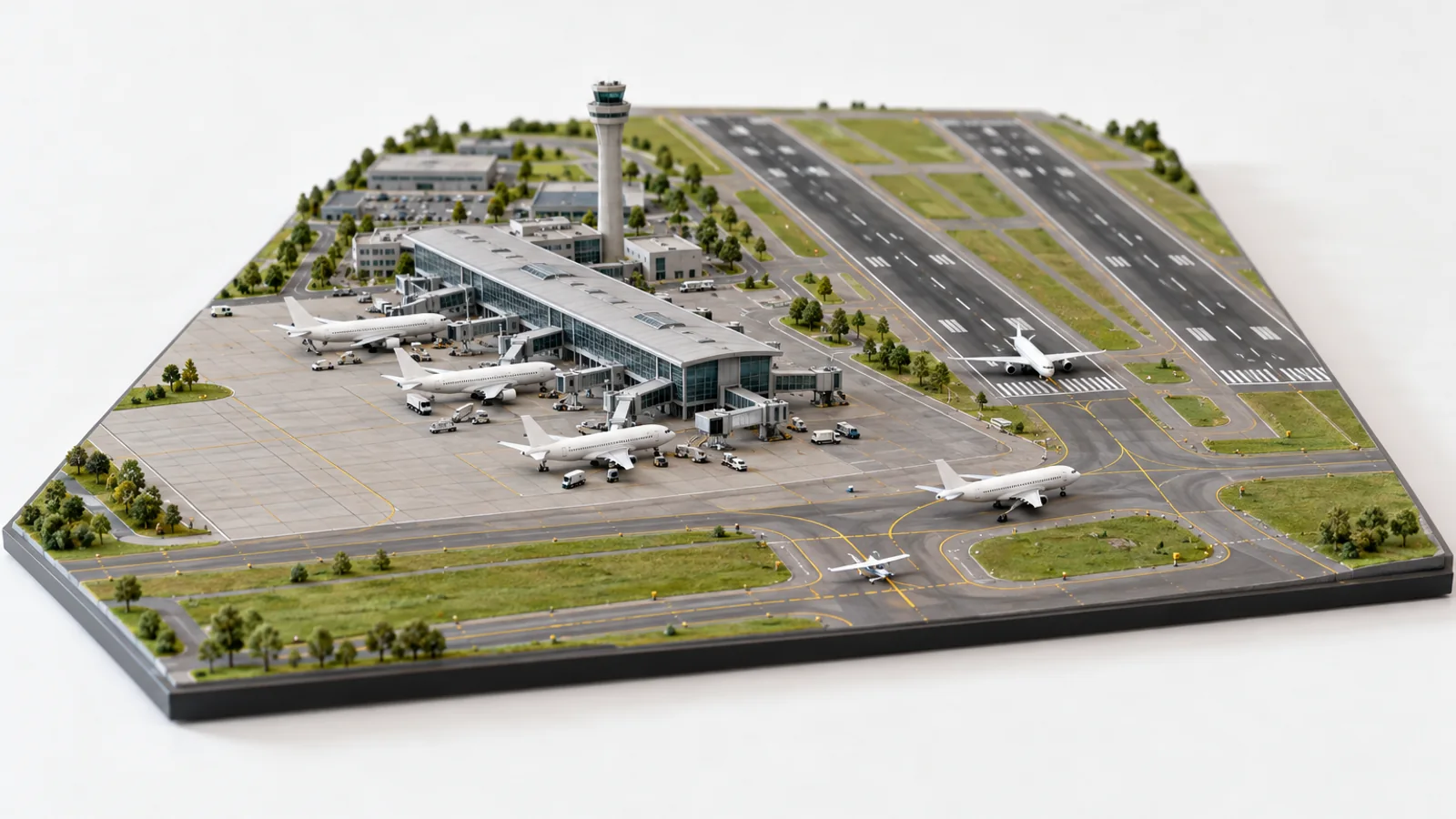
This guide covers US private-pilot airplane study and ordinary VFR operations. The miniature airport hero illustrates a busy airport environment; it is not a real airport map, airspace boundary or authorization for a student to fly there.
What are the key Class B requirements?
Clearance, pilot eligibility, aircraft equipment and weather are separate conditions that must all fit the operation.
| Requirement | What to remember | Official source |
|---|---|---|
| Entry | Receive ATC clearance before operating within Class B | 91.131(a)(1) |
| Radio | Operable two-way radio on the appropriate ATC frequencies, unless authorized otherwise | 91.131(c) |
| Surveillance equipment | Required transponder with automatic altitude reporting and ADS-B Out; deviations are separate | 91.215, 91.225 |
| Basic VFR weather | 3 statute miles flight visibility; clear of clouds | 91.155(a) |
| Private-pilot student solo | Specific training and logbook endorsements dated within the preceding 90 days | 61.95(a)–(b) |
| Restricted primary airports | At least a private pilot certificate for the PIC to take off or land at listed airports | 91.131(b)(2) |
The familiar wedding-cake picture is only a learning aid. Class B areas are individually tailored around major airports, generally from the surface to 10,000 feet MSL, with a surface area and multiple layers. Actual lateral limits, floors and ceilings come from current charts and published information (FAA AIM 3-2-3).
What counts as a Class B clearance?
You need the actual authorization to enter Class B; a callsign acknowledgement, transponder code or radar identification alone does not provide it.
For an original radio example, “N123AB, cleared through the Bravo, maintain 3,500” contains explicit Class B authorization and an altitude instruction. Follow the clearance's route, altitude and other conditions. By contrast, “N123AB, standby,” “squawk 4721,” or “radar contact” alone does not establish a Class B entry clearance.

Original simplified radio examples, not a complete transmission script. A clearance permits only the operation and conditions ATC authorized; pilot, equipment and weather requirements remain.
Contact the controlling facility before reaching the boundary. Report position, altitude and requested operation. ATC may offer a different route, delay clearance or require you to remain outside. A requested route is not a cleared route.
91.131(a)(1) and AIM 3-2-1/3-2-3 retain your clearance responsibility while receiving radar advisories. Clarify an unclear clearance before crossing; flight following does not automatically authorize entry.
This differs from ordinary Class C/D arrival or through-flight communication: a controller's acknowledgement of your aircraft identification can establish the required two-way communication there. Do not transfer that rule to Class B.
How do you read Class B shelves on a chart?
Read each sector's floor and ceiling in feet MSL, then compare them with your altitude and lateral position.
Sectionals and Terminal Area Charts depict Class B with solid blue boundaries and blue altitude figures. The last two zeros are omitted. In a hypothetical sector labeled 100/40, the ceiling is 10,000 feet MSL and the floor is 4,000 feet MSL. An airplane at 3,500 feet MSL is below that shelf; one at 4,500 feet MSL is within its vertical range if also within its lateral boundary.

Hypothetical sector, compressed scale and no real chart location. The Mode C veil is a separate equipment area; being below a Class B shelf does not identify the underlying airspace.
A plus sign before a floor indicates airspace extending upward from above the stated altitude, so operations at and below that marked floor are outside Class B. Read the sign and sector notes rather than treating all floors alike. These conventions are explained in the FAA Chart Users' Guide, pages 16–17 and 26.
Below a shelf, identify the underlying class, weather rules and surrounding equipment requirements. “Below Bravo” does not automatically mean Class G or remove those rules.
What equipment does a VFR airplane need?
For the usual equipped trainer, plan on an operable two-way radio, a compliant altitude-reporting transponder and compliant ADS-B Out for Class B.
The radio rule is in 91.131(c)(2), transponder and automatic pressure-altitude reporting in 91.215, and ADS-B Out in 91.225. A portable traffic display or ADS-B In receiver does not satisfy ADS-B Out.
For IFR operations, 91.131(c)(1) also requires an operable VOR or TACAN receiver, or an operable and suitable RNAV system. That is a separate IFR navigation requirement; do not turn it into a universal VFR requirement for a VOR receiver.
The veil's no-engine-driven-electrical-system provisions do not automatically permit unequipped flight inside Class B. A routine entry clearance is not evidence of a separate equipment deviation. Check its specific conditions and required authorization before relying on one.
Is the 30 NM Mode C veil the Class B boundary?
No: the veil is a separate equipment-required area, so you can be outside Class B and still need a transponder and ADS-B Out.
For airports listed in Appendix D, section 1, the usual veil extends 30 nautical miles from the airport, from the surface upward to 10,000 feet MSL. Its chart depiction is a solid magenta line; the Class B boundaries are blue. Do not equate that 30 NM radius with a Class B sector's lateral boundary (91.215(b)(2), 91.225(d)(2), Chart Users' Guide, page 17).
| Position, for an ordinarily equipped airplane | Class B entry clearance? | Surrounding equipment consideration |
|---|---|---|
| Inside the actual Class B volume | Required | Transponder/altitude reporting and ADS-B Out requirements apply |
| Below a shelf, outside B, but inside the applicable veil | No B entry clearance solely for that position | Veil equipment requirements still apply, subject to their exceptions |
| Above the B ceiling, within its lateral boundaries, up to 10,000 ft MSL | Outside that B volume | Separate overhead equipment provisions apply |
Sources: 91.131, 91.215(b)(4) and 91.225(d)(3). These positions do not remove requirements of another class or a temporary restriction.
Veil exceptions specify aircraft configuration, excluded classes and altitude ceilings; consult both regulations because their scopes differ. Equipment requirements also exist beyond a veil.
Can a student pilot solo in Class B?
A student seeking a private pilot certificate can solo in a specific Class B area only after the training and logbook endorsement required by 61.95, with separate airport requirements where applicable.
For the airspace area, 61.95(a) requires ground and flight training on that Class B area; the flight training must be received in the specific area. The instructor who provided the flight training must endorse the logbook, stating that the required training was received and the student was found proficient for solo in that area. The endorsement must be dated within the 90-day period preceding the flight.
For solo to, from or at an airport within Class B, paragraph (b) separately requires ground and flight training at the specific airport and an instructor endorsement documenting proficiency for solo operations there, also dated within the preceding 90 days. An endorsement for one Class B area or airport does not authorize every other area or airport.

Area and airport requirements are distinct. Specific Class B endorsements do not replace other required solo authorizations, instructor limitations, aircraft requirements or ATC clearance.
Student PIC limits in 61.89 remain: 3 statute miles flight or surface visibility by day, 5 at night, surface reference and instructor logbook limitations. Class B's general 3 SM row does not waive the student's night restriction.
Section 61.95 excludes students seeking sport or recreational certificates; their rules differ. Study-app results cannot replace instructor training, proficiency assessment or signed endorsements.
Which airports prohibit student solo takeoff or landing?
The airports covered by 91.131(b)(2) require the PIC to hold at least a private pilot certificate for civil-aircraft takeoff or landing, despite the general student exception.
The list is Appendix D to Part 91, section 4, reproduced in AIM 3-2-3. It includes Chicago O'Hare, Los Angeles International, Atlanta Hartsfield and Dallas/Fort Worth, among others. Check the full list; not every Class B primary airport is listed.
An instructor's Class B endorsement cannot waive 91.131(b)(2). Training with an eligible instructor acting as PIC is different from student solo. The listed-airport restriction concerns takeoff and landing; it is not a blanket ban on appropriately authorized student solo transit elsewhere in the Class B area.
What weather and speed limits should you check?
Basic Class B VFR needs 3 SM flight visibility and clear of clouds, while airport surface-area provisions, student limits and speed rules add separate conditions.
| Weather condition | Minimum or requirement | Source |
|---|---|---|
| Basic VFR in Class B | 3 SM flight visibility and clear of clouds | 91.155(a) |
| Basic VFR beneath the ceiling in controlled airspace designated to the surface for an airport | Ceiling must not be less than 1,000 ft | 91.155(c) |
| Basic VFR takeoff, landing or airport traffic-pattern entry in the designated surface area | At least 3 SM reported ground visibility; if unreported, at least 3 SM flight visibility during the operation | 91.155(d) |
| Student acting as PIC | At least 3 SM flight or surface visibility by day, 5 SM at night; instructor limitations also apply | 61.89(a)(6)–(8) |
Special VFR has separate provisions; an ordinary Class B clearance does not authorize below-minimum weather. Legal minima also do not establish a suitable personal weather margin.
91.117 normally limits flight below 10,000 feet MSL to 250 knots indicated airspeed, unless otherwise authorized by the Administrator. In airspace underlying a Class B area, or in a designated VFR corridor through it, the limit is 200 knots indicated. The minimum-safe-airspeed provision in paragraph (d) remains applicable. Do not generalize the 200-knot rule to every flight inside Class B.
What should you plan before a Class B flight?
Plan both the intended operation and a route that remains outside if clearance is unavailable.
Review current chart sectors, the controlling frequencies, airport procedures and applicable restrictions with your instructor. Confirm pilot eligibility, required endorsements and equipment status. For training at an airport within Class B, 91.131(a)(3) requires compliance with any training procedures ATC established for that area.
A Class B clearance does not supply a landing or taxi clearance. The appropriate ATC clearance for runway/taxiway operations and takeoff or landing remains separately required under 91.129(i), which 91.131 incorporates. Read back and clarify instructions, and continue to manage terrain, weather, traffic and wake-turbulence risk; the AIM explicitly retains those pilot responsibilities.
Check yourself
These are original learning scenarios, not released FAA test questions.
1. Approach says “N123AB, radar contact” and assigns a squawk code. Can you enter Class B?
Show the answer
Not on that exchange alone. Aircraft identification and a code do not provide an explicit Class B entry clearance. Remain outside and obtain the actual authorization; then comply with its conditions and the other applicable requirements.
2. You are at 3,500 feet MSL under a hypothetical 100/40 shelf, inside the applicable 30 NM veil. Does being below B remove the equipment requirement?
Show the answer
No. The shelf's floor is 4,000 feet MSL, so this position is below that Class B sector. The veil is separate and can still require the transponder, altitude reporting and ADS-B Out. Identify the underlying class and check any applicable equipment exception or authorization.
3. Your instructor endorsed solo in this Class B area 94 days ago. ATC offers a clearance today. Does that make the endorsement current?
Show the answer
No. Section 61.95 requires the applicable endorsement to be dated within the preceding 90-day period. ATC clearance does not renew instructor authorization. Airport-specific training/endorsements and the listed-airport private-certificate restriction must also be checked when relevant.
Frequently asked questions
Does flight following include Class B clearance?
No. Radar advisories do not remove your responsibility to obtain the required Class B clearance before entry. A route request, squawk assignment or callsign response alone is insufficient.
Is ADS-B In enough for Class B?
No. The regulation requires qualifying ADS-B Out. Receiving traffic or weather on a portable display does not establish that the airplane transmits the required compliant surveillance data.
Does a plane without an electrical system get a blanket Class B exemption?
No. The relevant veil exceptions have location and altitude conditions, including remaining outside Class B. Do not use an exception for surrounding airspace as automatic permission for unequipped entry into B; any required deviation must be specifically authorized.
Does an airport-specific endorsement allow solo landing at O'Hare?
No. O'Hare is on the official list requiring at least a private pilot certificate for the PIC to take off or land. A student solo endorsement cannot override that restriction, even if ATC would otherwise issue a clearance.
What should you study next?
Use airspace classes explained for the overall classification and chart picture, then compare VFR weather minimums by airspace. The FAA written-test endorsement guide explains a separate knowledge-test authorization; it does not replace Class B flight-training endorsements.
Practise clearance and eligibility scenarios with FirstSolo.ai. It is solely a study tool and does not issue endorsements now or in the future.
Sources and review notes
- 14 CFR 91.131: Class B operating rules, pilot eligibility, listed-airport restriction and radio/navigation equipment.
- FAA AIM 3-2-1 and 3-2-3: clearance responsibility, individually tailored areas, airport list and pilot responsibilities.
- 14 CFR 91.215 and 91.225: transponder/altitude reporting, ADS-B Out, veil, overhead provisions, exceptions and deviations.
- 14 CFR 61.95 and 61.89: specific private-pilot student solo requirements and continuing student PIC limits.
- 14 CFR 91.155, 91.117 and 91.129(i): weather, speed and separate airport clearances.
- FAA Chart Users' Guide, linked July 9, 2026 edition, pages 16–17 and 26: Class B chart labels and Mode C veil depiction.
Facts checked October 12, 2026 against the current official sources; eCFR displayed Title 14 updated through October 8. Figures and radio scenarios are original teaching aids. Technical review remains pending before publication.
FirstSolo.ai is independent and is not affiliated with or endorsed by the FAA.
About the author
Sam Whitaker, Student PilotSam is a student pilot training in a Piper Warrior outside Denver, Colorado, fitting lessons around a full-time job. He writes up the practical side of the FAA written, from booking the test to what to bring on the day, with the FAA source for every rule.
Last reviewed Oct 12, 2026All guides by SamKeep going
Start here · AirspaceAirspace Classes Explained: A, B, C, D, E and G
VFR Weather Minimums Chart: The Complete Table
Use the complete US airplane VFR weather table, then check Class G altitude rules, student visibility limits and airport surface-area conditions.
Ellie Navarro · Oct 11, 2026 · 10 min readA fresh question from the FAA references every time, graded by an AI DPE
Start with 50 free credits.
Start free