What to Bring to the FAA Knowledge Test
For the FAA Private Pilot Airplane knowledge test (PAR), bring acceptable identification, your test authorization, and any additional documents your situation requires. Have your Federal Tracking Number (FTN) and appointment details handy; bring only test aids the proctor accepts. Check your identification and endorsement before leaving home so a missing document does not derail the appointment.

On this page
- What are the key facts for the PAR test?
- Which documents should you pack first?
- What identification is acceptable?
- Which endorsement or authorization do you need?
- What changes if you are retesting after a failure?
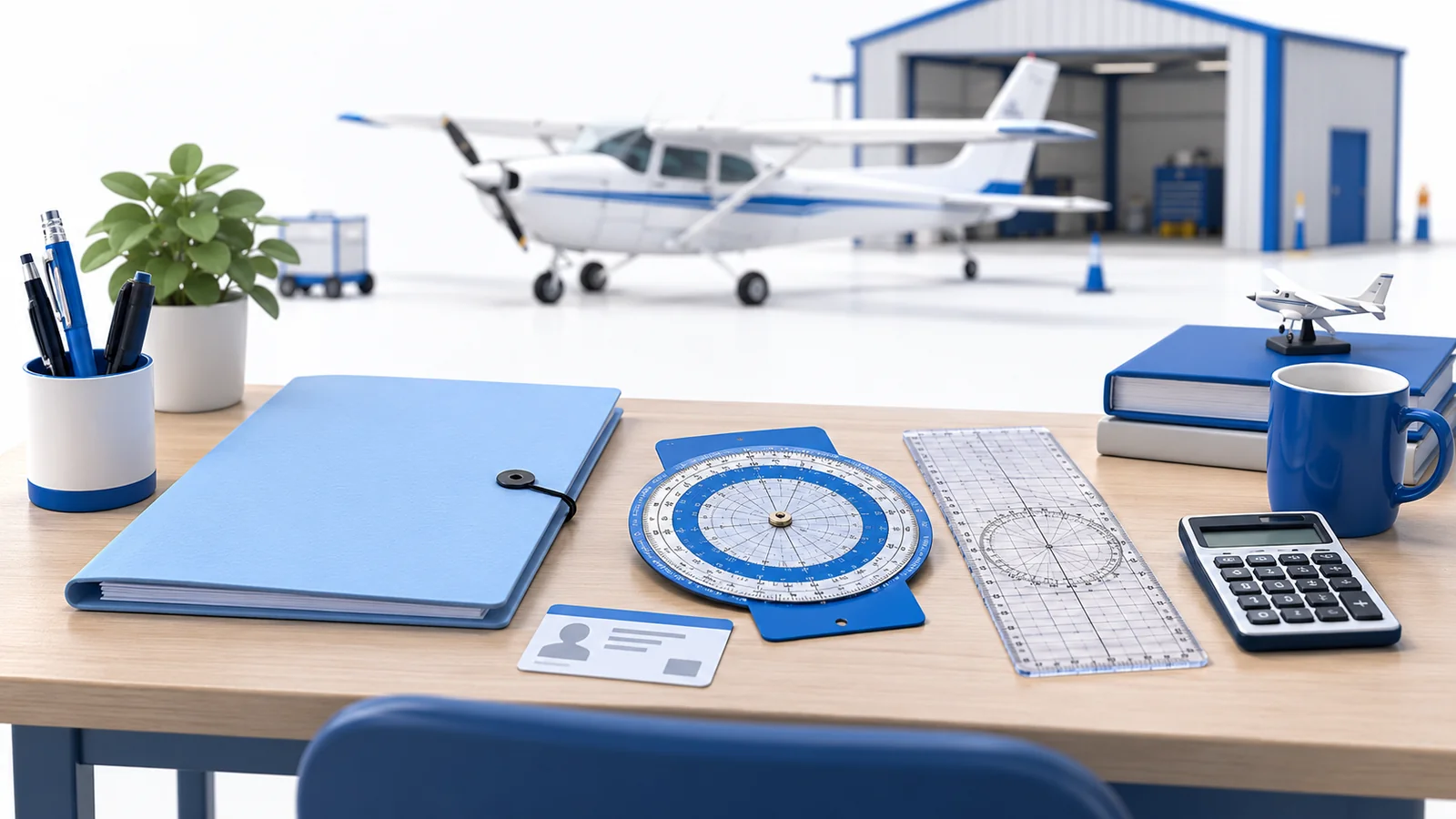
- Can you bring an E6B, plotter or calculator?
- Do you need to bring the FAA testing supplement?
- What should you check the night before?
- Check yourself
- Frequently asked questions
- Next steps
- Sources
What are the key facts for the PAR test?
PAR is the Private Pilot Airplane knowledge test; check that code on your booking before packing.
| Item | What to know | Official source |
|---|---|---|
| Test code | PAR — Private Pilot Airplane | FAA testing matrix, page 13 |
| Scored questions | 60; additional unscored validation questions may appear | FAA testing matrix, pages 2 and 13 |
| Time and passing score | 2 hours; 70% to pass | FAA testing matrix, page 13 |
| Minimum test age | 15 for PAR | FAA testing matrix, page 13 |
| Identification | Valid, current documents covering photo, birth date, signature and physical residential address | FAA identification FAQ |
| Authorization | An accepted instructor statement/logbook endorsement or FAA-certificated pilot-school graduation certificate | FAA testing matrix, page 13 |
The test-age minimum is different from eligibility for the private pilot certificate. This checklist covers the ordinary PAR appointment, not the checkride or another knowledge-test code. If your confirmation shows a different test, resolve that with the provider before test day.
Which documents should you pack first?
Pack your identification and accepted authorization first, then add documents needed for an address issue, retest or approved accommodation.
Use a small folder so check-in paperwork stays together. Keep the FTN and appointment confirmation accessible for reference; they help you locate the correct booking but do not replace identification or authorization. If you still need an FTN or appointment, use our FAA knowledge-test scheduling guide.

Start with admission documents. Add the conditional items that apply to you, then consider approved test aids.
Lay the documents beside your booking and compare the name and test code. Open a digital endorsement now rather than discovering at reception that the account needs a password reset. Ask the center which document format it accepts, and keep a legible paper copy as a backup where appropriate. Your phone is useful for travel and check-in, but it will not be a reference library in the testing room.
What identification is acceptable?
Your identification must be valid and current, and your documents together must establish your photo, date of birth, signature and physical residential address.
The FAA lists several acceptable forms, including government-issued identification and passports. The citizenship/residency columns in the FAA testing matrix, page 1 differ: the non-U.S.-citizen column requires a passport plus a listed government ID. Read the column that applies to you rather than assuming one document works for everyone.
| Situation | What to resolve before the appointment |
|---|---|
| ID has no residential address | Add accepted address verification; a passport alone may leave this field uncovered |
| Address is a P.O. box | Arrange verification of a physical residence |
| ID has expired | Arrange valid, current identification before test day |
| Applicant under 18 has no acceptable ID | The matrix permits a parent/legal guardian with acceptable ID to accompany the applicant and attest to identity |
| Unusual documents or asylum-related passport issue | Contact the center and, where the matrix requires it, the FAA in advance |
These conditions come from the FAA testing matrix, pages 1 and 4. A minor who already has acceptable identification does not automatically need a parent for this identification exception.
For address verification, examples on the FAA list include a signed lease, mortgage statement, or water, electric or gas statement. Cable-company statements are explicitly excluded. Bring an item from the actual list and ask about your particular combination of documents before traveling. An arbitrary bill or a screenshot of an account profile is not a reliable substitute.

Several documents can cover the required information together. Check the applicable FAA identification category as well.
Which endorsement or authorization do you need?
For an initial PAR attempt, bring an accepted authorization that establishes your preparation and readiness for that test.
The usual instructor route is a written statement or logbook endorsement from an authorized flight or ground instructor. 14 CFR 61.35 sets the knowledge-test prerequisites; the FAA testing matrix, page 13 also lists the graduation-certificate route from an FAA-certificated pilot school.
Read the whole document. Check that it identifies you and the intended test and includes the issuer's required signing details. A practice score, purchase receipt or course progress bar does not serve the same purpose as the accepted authorization. If something is missing, contact the issuer while there is time to correct it.
For help with the instructor route, read who can sign your knowledge-test endorsement. FirstSolo.ai is a study tool and does not issue endorsements. Arrange your authorization separately with an appropriate instructor or accepted school source.
What changes if you are retesting after a failure?
A PAR retest after failure requires the applicable failed Airman Knowledge Test Report (AKTR) and a new endorsement following additional training.
The instructor who gave the additional training must determine that you are proficient to pass before endorsing the retest (14 CFR 61.49(a)). The FAA testing matrix, page 13 specifies the failed report and acceptable retest-endorsement formats. Your original endorsement alone does not satisfy this additional requirement.
Keep the failed report and retest endorsement together in your folder. Before handing over the report, retain a copy for your own study records; the current matrix instructs the proctor to scan it and destroy it after verifying the electronic capture. Use its deficient-area codes to organize the training conversation, rather than treating another booking as the first corrective step.
Can you bring an E6B, plotter or calculator?
You may bring qualifying aviation test aids, but the proctor inspects them and makes the final decision on what enters the testing area.
The active FAA Order 8080.6H, chapter 3, paragraphs 4 and 6 covers navigation computers, plotters and calculators. Calculator memory must meet its restrictions and be cleared as directed. A phone-based E6B is not a substitute for an accepted standalone aid.
| Bring for inspection | Keep outside the testing area |
|---|---|
| Familiar mechanical E6B or qualifying aviation calculator | Phone, tablet and recording-capable devices |
| Plotter or straightedge | Personal notes, study guides and calculator instruction booklets |
| Qualifying calculator with erasable memory | Stored test-related programs or information |
The test center provides scratch paper and a writing instrument on request. Follow its storage instructions for personal belongings. These restrictions and the proctor's final authority are in FAA Order 8080.6H, chapter 3.

An allowed category is not a guarantee that every model is accepted. Ask about unfamiliar equipment before test day.
Practice with the equipment you intend to use. Borrowing a different calculator the night before adds an avoidable learning task. If your center supplies a calculator, ask what to expect and practice the same kind of basic operations ahead of time.
Older packing lists may cite AC 60-11C. The FAA cancelled that circular on August 22, 2025; use the current order and your center's instructions for this appointment.
Do you need to bring the FAA testing supplement?
Use the reference materials supplied through the testing center and its testing system; leave your own study copy outside the exam room.
The FAA's August 2026 Airman Testing Community Advisory, page 5 says private-pilot tests already feature questions with embedded images. It also says the date for removing supplements from centers had not yet been set and that candidates continue to have access until removal. Do not assume every figure will appear only in a printed book.
At check-in, ask how to access the figures and use the available measuring tools. Take the offered interface tutorial seriously: finding a figure, changing a view and returning to a question are skills worth settling before the clock starts. The advisory points applicants to the provider's sample questions for familiarity with the new format.
What should you check the night before?
Confirm the booking, prepare the admission documents and plan the trip using the instructions for your specific center.
- Read the appointment confirmation for arrival time, location and check-in instructions.
- Check the folder against the identification and authorization sections above.
- Confirm any agreed accommodation and bring the documentation the center requests.
- Set out familiar aids and a plan for storing personal belongings.
- Work out parking and building access; an airport address may cover several buildings.
Use the arrival time in your confirmation rather than a universal number from an old blog. If a rule or document is unclear, contact the testing center before leaving home. Resolve administrative problems first, then stop cramming and get some rest.
After the test, check your report's identifying information and retain it for the next stage of training. The FAA knowledge-testing FAQ explains the AKTR and how to obtain a duplicate. Bring the report to your instructor so the missed-area codes become a useful review plan.
Check yourself
These are original logistics scenarios, not released FAA test questions.
1. You have a current passport but no document showing your home address. Are you ready?
Show the answer
Not yet. Check your applicable identification category and add accepted residential-address verification. The required information can span more than one document; the address still needs to be covered (FAA testing matrix, pages 1 and 4).
2. You failed PAR last week and still have the first endorsement. Is that enough for another attempt?
Show the answer
No. Complete the additional training, obtain the retest endorsement from the instructor who gave it, and bring the failed report. The original endorsement does not establish the additional preparation required after failure (14 CFR 61.49).
3. Your favorite E6B runs on your phone. Can you use it during PAR?
Show the answer
No. A useful study app does not make the phone an approved test aid. Use qualifying standalone equipment accepted by the proctor and secure the phone outside the testing area (FAA Order 8080.6H, chapter 3).
Frequently asked questions
Does every student pilot need the same document list?
The core checks are identification and test authorization, but age, citizenship/residency, address documentation and retest status can change the paperwork. Follow the column and test-code row that apply to you in the FAA testing matrix.
Can I show my endorsement on my phone?
Ask the center how it accepts electronic authorizations before the appointment. Do not rely on an improvised phone screenshot at reception. Keep the complete document and signing details available in the format the center confirms.
Do I need to buy a new flight computer for the exam?
Choose a familiar aid that the center accepts. Ask whether it supplies a calculator and whether your existing equipment meets its requirements before buying anything solely for test day.
Can FirstSolo.ai supply my endorsement?
No. FirstSolo.ai helps you study and does not issue endorsements. Make the authorization arrangements separately.
Next steps
For the whole process, read the private pilot written-test guide. Use the scheduling guide to check your booking and the endorsement guide to resolve authorization questions.
Use FirstSolo.ai to practice private-pilot knowledge topics before your appointment, then take unresolved questions to your instructor.
Sources
- 14 CFR 61.35: knowledge-test prerequisites and identification
- 14 CFR 61.49: retesting after failure
- FAA Airman Knowledge Testing Matrix, revised September 25, 2026: pages 1, 2, 4 and 13
- FAA identification FAQ: required identifying information
- FAA Order 8080.6H, active: chapter 3, test materials and permitted aids
- FAA August 2026 Airman Testing Community Advisory: page 5, embedded graphics and supplement transition
- FAA knowledge-testing FAQ, updated June 1, 2026: test reports
FirstSolo.ai is independent and is not affiliated with or endorsed by the FAA. FirstSolo.ai does not issue knowledge-test endorsements.
About the author
Sam Whitaker, Student PilotSam is a student pilot training in a Piper Warrior outside Denver, Colorado, fitting lessons around a full-time job. He writes up the practical side of the FAA written, from booking the test to what to bring on the day, with the FAA source for every rule.
Last reviewed Oct 6, 2026All guides by SamKeep going
Start here · The testThe FAA Private Pilot Written Test: Complete 2026 Guide
FAA Written Test Endorsement: Who Signs It and What It Says
An FAA written test endorsement confirms your preparation and readiness. Learn who can sign, how home-study reviews work and what to check before test day.
Ellie Navarro · Oct 5, 2026 · 8 min read
How to Schedule the FAA Knowledge Test: FTN, IACRA and PSI
The four steps to booking the FAA private pilot written: your FTN from IACRA, a PSI account, the PAR test and a center, and the fee. Plus what to bring.
Sam Whitaker · Oct 4, 2026 · 7 min readA fresh question from the FAA references every time, graded by an AI DPE
Start with 50 free credits.
Start free