Class C Airspace Requirements: Radio Rules
Class C airspace requirements for an arrival or through flight include establishing two-way radio communication with the ATC facility providing services before entry, then maintaining it inside. A response with your aircraft identification—even “standby”—establishes communication, but a “remain outside” instruction still controls; an unidentified “aircraft calling, standby” does not establish it. Equipment and weather requirements also apply (91.130(c), FAA AIM 3-2-4).

On this page
- What are the key Class C requirements?
- What does two-way radio communication actually mean?
- Do you need to hear “cleared into Class C”?
- Which facility should you call, and when?
- How do you read the core, shelf and altitude labels?
- Is the outer area another Class C ring?
- What radio rules apply to departures?
- What equipment, weather and speed rules also apply?
- What services begin after radio and radar contact?
- Can a private-pilot student use the same entry rule?
- Check yourself
- Frequently asked questions
- What should you study next?
- Sources and review notes
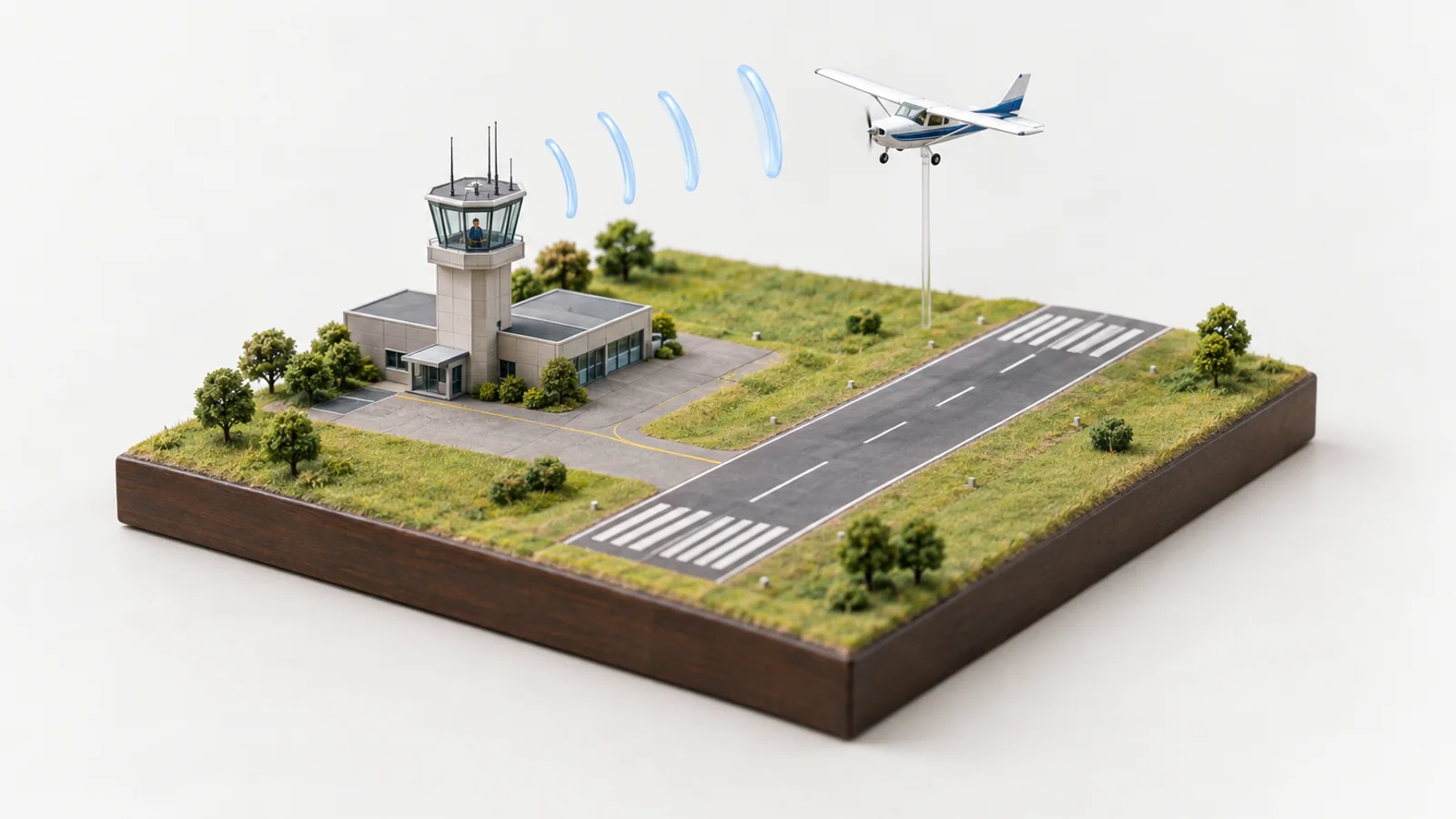
This guide covers US private-pilot airplane study and ordinary VFR operations. The supplied miniature hero uses radio arcs to illustrate communication; it does not show radio range, a real airport layout or the facility you should call for every Class C arrival.
What are the key Class C requirements?
Use the radio rule together with aircraft equipment, weather, chart boundaries and any ATC restrictions.
| Requirement | What to remember | Official source |
|---|---|---|
| Arrival or through flight | Establish two-way communication with the facility providing services before entry; maintain it inside | 91.130(c)(1) |
| Callsign response | Your aircraft identification plus “standby” establishes communication; obey any remain-outside instruction | AIM 3-2-4 |
| Equipment | Two-way radio; required altitude-reporting transponder and ADS-B Out, subject to authorized deviations | 91.130(d) |
| Basic VFR weather | 3 statute miles flight visibility; 500 ft below, 1,000 above and 2,000 horizontally from clouds | 91.155(a) |
| Typical shape | 5 NM surface core, 10 NM shelf, generally to 4,000 ft above airport elevation; actual configuration varies | AIM 3-2-4 |
| Nearby speed rule | Normally no more than 200 knots indicated at or below 2,500 ft AGL within 4 NM of the primary airport | 91.117(b) |
NM means nautical miles; weather visibility uses statute miles. MSL is altitude above mean sea level. AGL is height above the surface, while Class C's typical vertical dimensions are described relative to airport elevation and charted in MSL. Keep those references distinct.
What does two-way radio communication actually mean?
Communication is established when the controller responds using your aircraft identification; entry also depends on any instructions and other requirements.
Consider three original learning examples:
- “N123AB, standby.” The controller identified your aircraft, so communication is established. You must still meet other requirements and comply with instructions.
- “Aircraft calling, standby.” Your aircraft was not identified. Communication is not established for entry; remain outside until it is.
- “N123AB, remain outside Class Charlie and standby.” Communication is established, but ATC specifically requires you to remain outside.

Original simplified arrival/through-flight examples, based on AIM 3-2-4. Meeting the communication condition does not waive equipment, weather or pilot restrictions.
The word “standby” alone is not the deciding factor. Listen for both aircraft identification and the rest of the instruction. A controller can acknowledge you while withholding entry because workload or traffic prevents immediate service.
Your first transmission, or a response intended for another aircraft, does not establish your two-way exchange. Resolve unclear identification or instructions while remaining outside.
The entry rule is in 91.130(c)(1); the callsign and standby examples are explained by AIM 3-2-4. They concern radio communication, not a guarantee of immediate radar separation.
Do you need to hear “cleared into Class C”?
Ordinary VFR arrival or through flight uses the established-communication requirement, rather than Class B's explicit airspace-entry clearance requirement.
In Class B, hearing your callsign or being told to standby alone does not grant entry. In Class C, a response identifying your aircraft establishes communication; entry remains subject to any remain-outside instruction and other requirements. Compare the full Class B requirements guide before treating the two exchanges as equivalent.
That distinction does not mean Class C is free of clearances. Landing, takeoff and taxi/runway operations at an airport with an operating control tower still require appropriate ATC clearances under 91.129(i), which 91.130 incorporates. An arrival communication exchange is not a landing clearance.
Which facility should you call, and when?
For an arrival or through flight, contact the ATC facility providing Class C services on the published frequency before entering.
That is commonly approach control; a tower call or CTAF broadcast does not automatically satisfy it. Identify the appropriate facility from current published information. The hero does not teach a universal tower-first procedure.
Call far enough from the boundary to establish contact before reaching it. Give position, altitude, radar beacon code, destination and your Class C service request, leaving time to resolve identification and instructions.
The usual 20 NM outer-area description does not establish a universal Class C boundary or a fixed latest calling point. Terrain, radio coverage and workload matter; leave room to remain outside if needed (AIM 3-2-4).
How do you read the core, shelf and altitude labels?
Read Class C's solid magenta boundaries and each sector's charted MSL floor and ceiling, not just the distance from the airport.
The typical layout has a 5 NM radius surface core and a 10 NM radius shelf. The top is generally 4,000 feet above airport elevation, and the shelf starts no lower than 1,200 feet above airport elevation. Configurations are individually tailored; these dimensions are study defaults, not navigational guarantees.
The FAA Chart Users' Guide, pages 16 and 27 explains that the magenta ceiling/floor figures omit the last two zeros. A hypothetical 45/17 shelf means 4,500 feet MSL over 1,700 feet MSL. 45/SFC means the corresponding sector extends from the surface to 4,500 feet MSL.

Original example: airport elevation 500 feet MSL, typical 4,000-foot height above the airport, and an assumed shelf floor 1,200 feet above it. The arithmetic illustrates MSL labels; actual charted limits govern.
The example's top is 500 + 4,000 = 4,500 feet MSL; its assumed shelf floor is 500 + 1,200 = 1,700 feet MSL. A point inside the shelf's plan-view boundary can still be below its floor. Determine the underlying class separately.
Some Class C ceiling labels use “T” to show a ceiling extending to, but not including, the overlying Class B floor. Read those chart notes and effective hours. Being outside C does not resolve any overlapping B clearance or equipment requirement.
Is the outer area another Class C ring?
The procedural outer area is distinct from Class C itself and normally extends around 20 NM from the primary airport.
The outer area is uncharted, with vertical limits based on coverage and delegated approach-control airspace, excluding C and other airspace as appropriate. Participation there is voluntary; it is not another regulatory C volume.
Within the actual Class C area, the entry and continuing-communication rules still apply. Do not use voluntary participation in the outer area as permission to enter C without the required radio exchange. Conversely, receiving Class C services in the outer area does not establish that your aircraft is already inside C (AIM 3-2-4).
What radio rules apply to departures?
The departure rule depends on whether the airport has an operating control tower, so it differs from an arrival or through flight.
| Operation | Communication requirement | Source |
|---|---|---|
| Arrival or through flight | Establish with the facility providing services before entry; maintain while inside | 91.130(c)(1) |
| Departure from the primary airport or a satellite airport with an operating tower | Establish and maintain with the tower, then communicate as ATC instructs within C | 91.130(c)(2)(i) |
| Departure from a satellite airport without an operating tower | Establish and maintain with the facility having jurisdiction as soon as practicable after departure | 91.130(c)(2)(ii) |
A satellite airport is another airport within the Class C area, rather than the primary airport for which the area is designated. The non-towered departure provision is not an arrival exception. Prepare the frequency and initial transmission before departure so you can establish contact as soon as practicable afterward.
Section 91.130(b) also requires compliance with FAA arrival/departure traffic patterns for takeoff or landing at a satellite airport. A Class C radio exchange does not replace applicable airport procedures.
What equipment, weather and speed rules also apply?
Two-way communication is one condition; required surveillance equipment and the applicable weather and speed limits remain separate.
For an ordinarily equipped trainer, Class C requires the appropriate altitude-reporting transponder and ADS-B Out, unless ATC authorizes otherwise (91.130(d), 91.215, 91.225). ADS-B In traffic on a portable display does not satisfy an ADS-B Out requirement. A radio acknowledgement is not evidence of a separate equipment deviation.
Equipment requirements also apply above C's ceiling within its lateral boundaries, upward to 10,000 feet MSL. C alone does not create a Class B-style 30 NM veil. Other equipment areas can overlap; outside C does not mean no requirement.
| Weather condition | Minimum or requirement | Source |
|---|---|---|
| Basic VFR in C | 3 SM flight visibility; 500 ft below, 1,000 above, 2,000 horizontally from clouds | 91.155(a) |
| Basic VFR beneath the ceiling in controlled airspace designated to the surface for an airport | Ceiling must not be less than 1,000 ft | 91.155(c) |
| Basic VFR takeoff, landing or airport traffic-pattern entry in the designated surface area | At least 3 SM reported ground visibility; if unreported, at least 3 SM flight visibility during the operation | 91.155(d) |
| Student acting as PIC | At least 3 SM flight or surface visibility by day, 5 at night; surface reference and instructor limits | 61.89(a)(6)–(8) |
Class C uses the 500/1,000/2,000-foot cloud distances; do not substitute Class B's clear-of-clouds rule. Special VFR is separate. Review the complete VFR weather table when comparing classes.
91.117(b) normally limits indicated airspeed to 200 knots at or below 2,500 feet above the surface within 4 NM of the primary airport, unless otherwise authorized or required by ATC. That is not a 200-knot limit everywhere in the 10 NM shelf. The separate 250-knot rule below 10,000 feet MSL, its Administrator authorization provision, and the minimum-safe-airspeed provision also remain relevant.
What services begin after radio and radar contact?
Class C services depend on both established two-way communication and radar contact, which are distinct from simply meeting the radio entry condition.
The AIM describes sequencing to the primary airport and Class C services in C and its outer area once those conditions exist. VFR aircraft receive separation from IFR aircraft using the specified methods; do not turn that into a promise of separation from every VFR aircraft.

Communication and radar identification are distinct. “Standby” with your identification is not a claim that radar separation has already started; ATC restrictions and pilot responsibilities still apply.
Class C services can be affected by a radar outage, and the AIM retains pilot responsibility for seeing and avoiding traffic, wake-turbulence avoidance, terrain and weather. If an instruction would compromise those responsibilities, advise approach control and obtain a revised clearance or instruction (AIM 3-2-4).
Can a private-pilot student use the same entry rule?
Class C has no Class C-specific minimum pilot certificate requirement, but student solo authorization and student PIC limitations still apply.
The AIM's “no specific certification required” statement concerns Class C. Private-pilot students still need applicable solo training and instructor authorization under Part 61, Subpart C, and must comply with 61.89.
Do not import Class B's special area/airport endorsement rule into Class C, or assume a controller's response renews an expired solo authorization. Students seeking sport-pilot privileges have additional airspace training/endorsement restrictions in 61.89(c). This guide's examples focus on private-pilot airplane study.
Check yourself
These are original learning scenarios, not released FAA exam questions.
1. Approach answers “Aircraft calling, standby” before you reach C. Is communication established for entry?
Show the answer
No. The controller has not used your aircraft identification, so that response does not establish the required two-way communication. Remain outside until the exchange is established, and comply with any further restriction.
2. Approach says “N123AB, remain outside Class Charlie and standby.” Can you enter because your callsign was used?
Show the answer
No. The callsign establishes communication, but the remain-outside instruction controls your operation. Meeting the radio condition does not cancel a restriction in the same transmission.
3. In the hypothetical 45/17 shelf, you are 6 NM from the airport at 1,400 feet MSL. Are you in that shelf?
Show the answer
No, assuming this point is outside the example's 5 NM surface core and under the illustrated shelf. Its floor is 1,700 feet MSL, so 1,400 is below it. Determine the underlying class and other requirements; the plan-view 10 NM boundary does not put every altitude inside C.
Frequently asked questions
Does “N123AB, standby” allow Class C entry?
It establishes the communication condition for an arrival or through flight. You must have no remain-outside restriction, meet the other applicable requirements, and maintain communication inside. The same response alone would not grant Class B clearance.
Must I hear “radar contact” before the radio condition is met?
No. A response identifying your aircraft can establish two-way communication without that phrase. Radar contact is a separate condition for the Class C services described by the AIM; do not assume it exists from a standby response alone.
Does Class C automatically have a 30 NM Mode C veil?
The Class C designation alone does not create that veil. Equipment is required within C and in specified airspace above it; a nearby listed-airport veil or other equipment rule may also apply to your location.
What happens outside published Class C service hours?
Check the published replacement airspace, effective hours and current operating information. The AIM says communications and equipment requirements depend on the class established outside the service hours. Do not assume every closed tower turns the area into Class G.
What should you study next?
Use airspace classes explained for the overall map, compare Class B entry and equipment rules, and practise choosing the right row in VFR weather minimums by airspace.
Practise radio-response scenarios with FirstSolo.ai. It is solely a study tool and does not issue endorsements now or in the future.
Sources and review notes
- 14 CFR 91.130: Class C arrival/through-flight and departure communication, satellite procedures, equipment and authorized deviations.
- FAA AIM 3-2-4: callsign responses, remain-outside instructions, typical dimensions, outer area, services, radar outages and operating hours.
- 14 CFR 91.215 and 91.225: surveillance equipment and overhead requirements.
- 14 CFR 91.155 and 91.117: weather and speed limits.
- 14 CFR 91.129(i): separate landing, takeoff and taxi clearances; 61.89 and Part 61 Subpart C: student authorization and limitations.
- FAA Chart Users' Guide, linked July 9, 2026 edition, pages 16 and 27: Class C magenta boundaries, MSL figures and “T” labels.
Facts checked October 13, 2026. Typical dimensions and original examples are explicitly qualified; current charts and operating information determine actual limits. Technical review remains pending before publication.
FirstSolo.ai is independent and is not affiliated with or endorsed by the FAA.
About the author
Ellie Navarro, Student PilotEllie is a student pilot working toward her private pilot certificate in a Cessna 172 near Austin, Texas. She writes up each part of the FAA written the way it finally made sense to her, with the FAA source for every rule.
Last reviewed Oct 13, 2026All guides by EllieKeep going
Start here · AirspaceAirspace Classes Explained: A, B, C, D, E and G
Class B Airspace Requirements: A Pilot's Guide
Learn which Class B clearance, equipment, weather and student-solo rules apply, and why a shelf, Mode C veil and airport restriction are separate.
Sam Whitaker · Oct 12, 2026 · 10 min read
VFR Weather Minimums Chart: The Complete Table
Use the complete US airplane VFR weather table, then check Class G altitude rules, student visibility limits and airport surface-area conditions.
Ellie Navarro · Oct 11, 2026 · 10 min readA fresh question from the FAA references every time, graded by an AI DPE
Start with 50 free credits.
Start free